
Imagine standing in a boardroom in New Cairo. The client is asking for a “futuristic yet culturally authentic” gala dinner concept. In the past, you would have nodded, taken extensive notes, and spent the next three days with a graphic designer trying to interpret that vague request.
Today, that workflow has collapsed from days into seconds.
With the latest rollouts in ChatGPT’s image generation (powered by the new GPT Image 1.5 model), we aren’t just “making pictures” anymore. We are engaging in a real-time, high-fidelity design conversation that bridges the gap between abstract thought and visual reality. For media professionals, event planners, and brand managers in Egypt, this isn’t just a fun toy—it is a fundamental shift in how we conceive, pitch, and greenlight projects.
But with great power comes a critical question: If AI can dream it, who actually builds it?
In this deep dive, we will explore the cutting-edge features of ChatGPT’s latest image toolkit, how to apply them to the Egyptian market, and where the digital dream meets the hard concrete of production reality.
The Evolution: From “Random Chaos” to “Precision Control”
Early AI image generation was like rolling dice. You asked for a “stage with red lights,” and you might get a stage with red lights, or you might get a red stage on fire. It was impressive, but chaotic.
The latest updates (specifically the transition to DALL-E 3 and the subsequent GPT Image 1.5 refinements) have introduced a level of semantic understanding and editorial control that changes the game entirely. The AI no longer just “guesses”; it listens.
1. The “Magic Brush”: In-Line Editing
The single most requested feature is finally here and robust: In-Line Selection and Editing.
Previously, if you generated a perfect storyboard frame for a commercial but the actor was holding a coffee cup instead of a soda can, you had to regenerate the entire image—often losing the perfect lighting or expression in the process.
How it works now:
You can simply click the “Select” tool, highlight the coffee cup, and type: “Replace with a sleek, unbranded silver soda can.”
* The Result: The AI analyzes the lighting, shadows, and grip of the hand, seamlessly swapping the object while leaving the rest of the image pixel-perfect.
* For Events: Imagine visualizing a wedding kosha design. The client loves the structure but hates the flowers. You highlight the flowers and type: “Change to white orchids with trailing ivy.” Done. In seconds.
2. Aspect Ratio Agility
Content is no longer one-size-fits-all. A TV commercial needs 16:9. An Instagram Reel needs 9:16. A Facebook post needs 4:5.
ChatGPT now allows you to toggle aspect ratios instantly without breaking the conversational flow. You can generate a wide cinematic shot for a pitch deck and then ask, “Now give me a vertical version of this focused on the center subject for a mobile mockup.” This fluidity allows media production teams to visualize cross-platform campaigns in a single session.
3. Style Consistency & Reference
Brand identity relies on consistency. One of the biggest hurdles with AI was that every image looked like it came from a different universe.
With the new Style Reference capabilities, you can upload a mood board or a specific brand asset and tell ChatGPT: “Keep this color palette and lighting style, but generate three different scenes.”
* Practical Use: For a corporate event in Alexandria, you can upload the company’s brand guidelines (hex codes and fonts) and generate signage mockups that actually look like they belong to the client, not a generic template.
Practical Applications in the Egyptian Market
How does this translate to the daily grind in Cairo? Whether you are filming a Ramadan ad or setting up a conference at the Al Manara Center, these tools are velocity multipliers.
A. The Event Planner’s “Virtual Venue”
Clients often struggle to visualize spatial arrangements. “What do you mean by a truss system?”
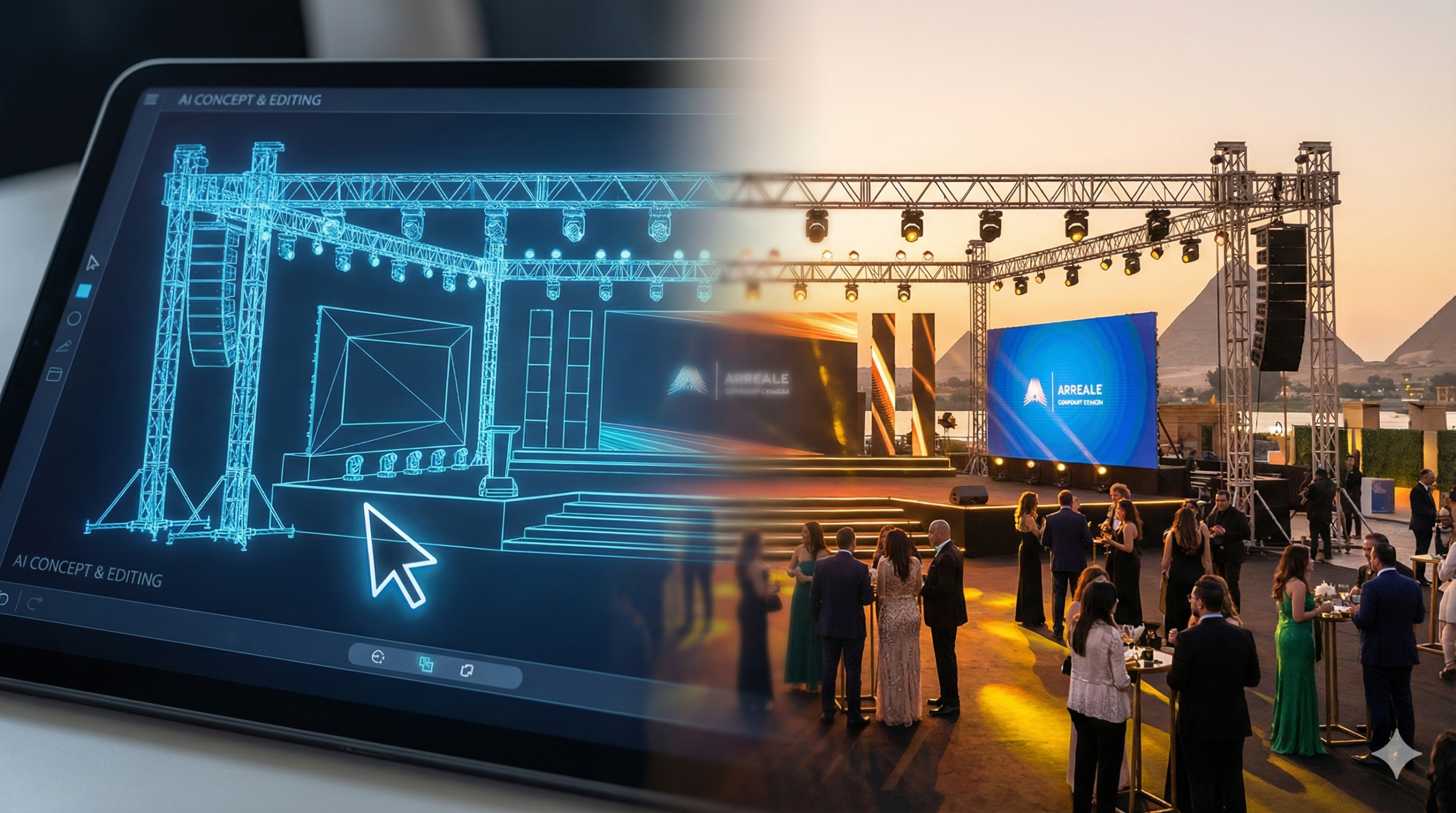
* The Workflow: You can ask ChatGPT to “Create a photorealistic visualization of a gala dinner setup at an outdoor venue overlooking the Nile at sunset. Round tables, gold Tiffany chairs, ambient purple uplighting, and a large LED screen on stage center.”
* The Pivot: When the client says “Too dark,” you don’t call the renderer. You type: “Make it a daytime brunch setting, change purple lights to natural sunlight, and replace LED screen with a floral arch.”
* Why it matters: You get client buy-in before you rent a single piece of furniture.
B. The Media Producer’s “Instant Storyboard”
In pre-production, communicating camera angles to a crew is vital.
* The Workflow: Instead of stick figures, directors can generate fully rendered frames. “Close-up, low angle, heroic shot of an Egyptian athlete tying their shoelaces on a running track. Golden hour lighting, shallow depth of field, cinematic style.”
* The Benefit: The Director of Photography (DOP) knows exactly what you want before they arrive on set. It aligns the crew on lighting, mood, and composition instantly.
The “Uncanny Valley”: Where AI Falls Short
Despite these miracles, AI remains a tool, not a replacement for expertise. It has blind spots, particularly in areas crucial to Strike Media’s operations.
* Physics & Logistics: AI can draw a floating stage, but it doesn’t know if that stage can physically support a 10-piece band. It can visualize a drone show, but it doesn’t know the airspace regulations over Cairo.
* Cultural Nuance: While improving, AI can still struggle with specific cultural markers. It might mix up specific traditional patterns or misinterpret the “vibe” of a local celebration unless guided by a human expert who knows the culture intimately.
* Text Rendering: While DALL-E 3 is much better at text, it still occasionally misspells brand names or produces gibberish on signage.
The Strike Media Advantage: We Build the Dream
This is where the partnership between Artificial Intelligence and Human Execution becomes the ultimate competitive advantage.
At Strike Media, we use these advanced AI tools to help you dream bigger and faster. We use them to storyboard your commercials and mock up your events so you can see the future before we build it.
But then, we put the boots on the ground.
* Media Production: We take that AI-generated storyboard and apply real lens choice, professional lighting, and expert color grading. We capture the human emotion that AI can only simulate.
* Events Management: We take that virtual venue design and calculate the load-bearing requirements, the power consumption, the safety exits, and the flow of the crowd. We turn the pixels into a physical experience that guests can touch, hear, and feel.
AI is the architect of the imagination. We are the engineers of reality.
Conclusion
The latest updates to ChatGPT’s image generation features—from in-line editing to style referencing—have democratized high-end visualization. They allow brands to iterate at the speed of thought.
However, a beautiful image is not a delivered project. The magic happens when you take that crystal-clear AI vision and hand it to a team that has the technical expertise, local knowledge, and production muscle to bring it to life.
Don’t just visualize your next big project—execute it.
Would you like us to generate a visual mood board for your upcoming event or campaign and show you how we can turn it into reality?
Sent from my Galaxy