

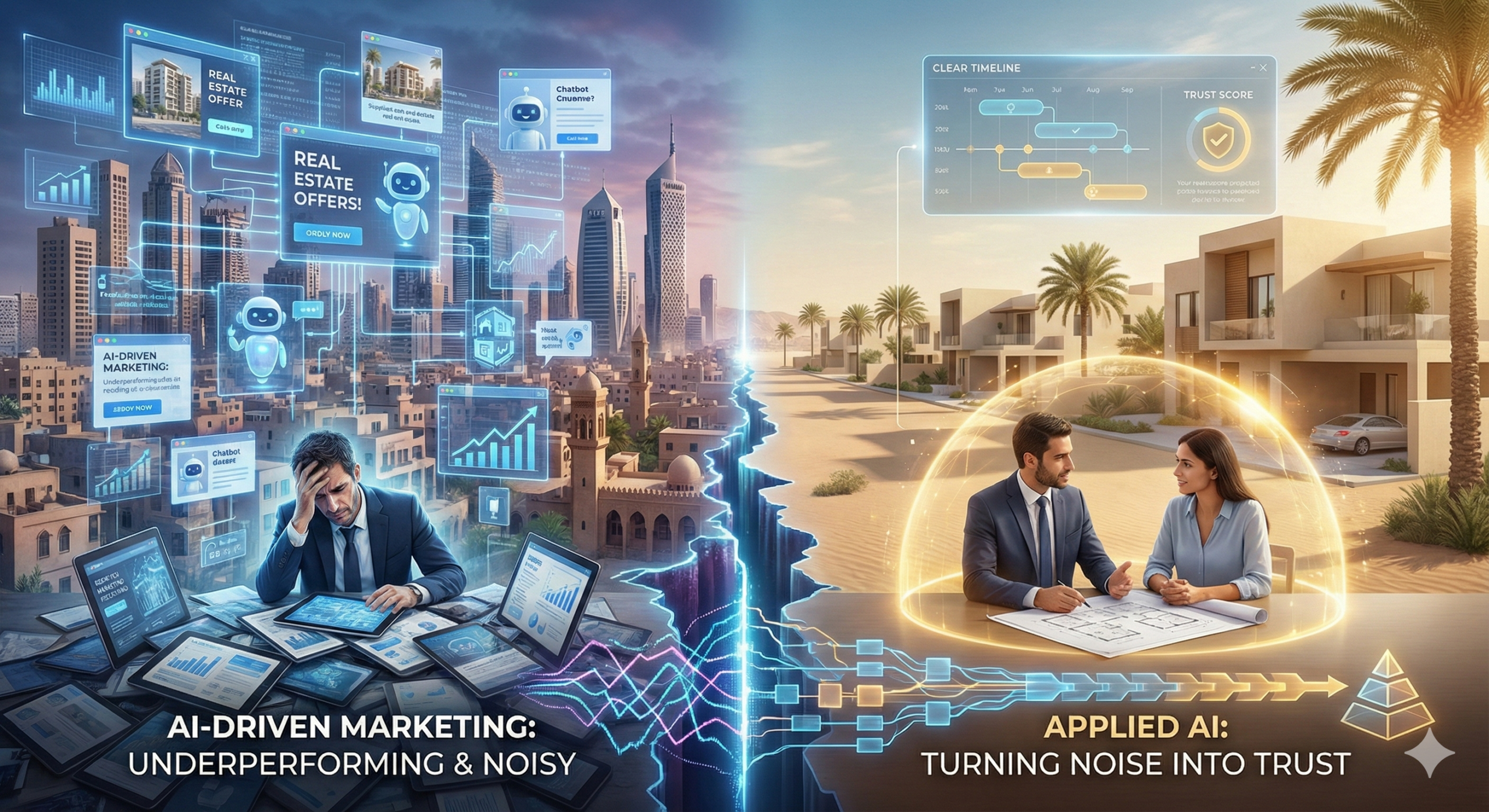
Introduction: The Paradox the Market Avoids
Artificial Intelligence has entered Egypt’s real estate marketing ecosystem aggressively.
Smarter ads. Automated content. Chatbots. Advanced targeting. Endless dashboards.
Yet despite this surge in intelligence, the outcome is unsettling:
Lead quality is declining
Trust is thinning
Differentiation is disappearing
The question is no longer:
Should we use AI in real estate marketing?
The real question is sharper, and less comfortable:
Why is AI not changing the results as promised?
The answer is not technological.
It is architectural.
AI is not failing the Egyptian real estate market.
It is being applied at the wrong layer of the system.
The Real Problem: AI Amplifies Execution, Not Understanding
Egyptian real estate marketing is structurally defined by:
Large inventories
Long decision cycles
Emotionally loaded investments
Constant sales pressure
When AI arrived, its application followed a predictable pattern:
More content
More ads
More leads
More automation
But real estate is not a volume problem.
It is a decision-friction problem.
AI was injected into execution channels while the real bottleneck remained untouched:
Hesitation
Doubt
Lack of trust
Narrative inconsistency
The system became faster—without becoming wiser.
Three Laws AI Cannot Break in Real Estate Marketing
1. The Law of Friction
Real estate is not a scale problem.
It is a trust problem.
AI can optimize clicks, impressions, and forms.
It cannot shortcut credibility.
When buyers are treated as data points instead of decision-makers, the system generates activity—not conviction.
2. The Law of Timing
Marketing speed must never outpace market trust.
AI enables rapid iteration:
Messages change weekly
Narratives reset constantly
Campaigns overlap aggressively
But in a trust-sensitive market like Egypt’s, credibility compounds slowly—and collapses quickly.
AI accelerates what already exists.
If coherence is missing, it accelerates confusion.
3. The Law of Reputation
Buyers do not purchase units.
They purchase developer history.
No algorithm carries a track record.
No chatbot has delivered a project.
AI can support reputation.
It can never replace it.
Where AI Specifically Breaks Down in Egypt’s Real Estate Marketing
1. Optimizing Metrics Without Building Conviction
AI excels at improving:
Click-through rates
Cost per lead
Form submissions
But Egyptian buyers optimize for something else entirely:
Safety
Credibility
Long-term value
Emotional reassurance
This creates a dangerous gap between dashboards and reality:
Inflated lead volume
Weak intent
Exhausted sales teams
AI did not misunderstand the buyer.
The system misunderstood the decision.
2. Automating the Wrong Moment in the Buyer Journey
Most AI deployments focus on:
The first click
The first message
The first interaction
But the most decisive moment in real estate is the pause after interest.
The moment when the buyer asks—silently:
Will this project actually be delivered?
Is this developer reliable?
Is this price justified—or just well advertised?
This is where most marketing systems go silent.
Or worse—they push harder.
The Smarter Alternative: Applied AI, Not Executional AI
Developers seeing real gains are not using AI to sell louder.
They are using it to understand better.
A Concrete Comparison: Before vs. After
The Old Way (Execution AI)
A user lingers on a pricing page.
The system detects “intent” and immediately retargets them with:
“Hurry! Only 2 units left!”
Result: pressure → anxiety → retreat.
The New Way (Applied AI)
The system interprets linger time as pricing hesitation, not intent.
It responds with a brochure titled:
“How Our Payment Plan Protects Your Cash Flow Over 5 Years.”
Result: reassurance → clarity → progression.
Same data.
Different architecture.
Opposite outcome.
What Actually Changes in Applied AI Systems
1. Decision Mapping Before Lead Generation
AI is used to identify:
Hesitation points
Perceived risk
Readiness signals
Not to inflate traffic—but to interpret intent.
2. Human-Controlled Narrative Layers
AI supports:
Analysis
Testing
Personalization
Humans retain control over:
Tone
Timing
Long-term narrative consistency
Real estate brands are not prompt-driven machines.
3. AI as a Signal Filter, Not a Megaphone
The most effective AI systems today:
Qualify seriousness
Prioritize human intervention
Reduce sales team fatigue
AI does not close deals.
It decides when humans should step in.
CEO Audit: A Three-Question Reality Check
Ask your marketing team—without prompting them:
Are we optimizing AI to generate more leads, or to filter for better ones?
Does our automation pause when a client hesitates—or does it keep pushing?
Can we trace our last ten sales back to a specific trust-building moment, or just a click?
If the answers are unclear, AI is running without governance.
The Hidden Risk: Short-Term Uplift, Long-Term Erosion
Yes, AI can create early performance spikes.
But without Applied Marketing Architecture, these gains decay into:
Brand dilution
Rising acquisition costs
Declining trust
In real estate, reputation compounds over years.
Short-term wins often mask long-term damage.
What Will Define Competitive Advantage Next
As AI becomes standard across developers, agencies, and brokers:
Execution advantage will disappear
Content parity will rise
Differentiation will collapse
What remains defensible is:
Clarity of positioning
Narrative discipline
Mastery of buyer psychology
AI will not decide who wins.
The system surrounding AI will.
Closing: From Insight to Action
Those who use AI to sell faster will compete on noise.
Those who use AI to engineer trust will quietly own the market.
We are building this Decision Architecture for a select group of real estate developers.
If you are ready to stop competing on noise, the blueprint is ready to be examined.


How Capital Hills Built a Cultural Moment with Karim Afify · The «في كل حته» Campaign Case Study
How one developer turned Egypt's fragmented buyer landscape into a single...

How Xiaomi Made Tamer Hosny Its Cultural Anchor in Egypt · The Brand Partnership Case Study
When a Chinese tech giant needed Egyptian credibility, it chose the country's...

One Creative · Three Languages · One Brand Voice — How Xiaomi’s «The Photo» Crossed Linguistic Borders
Xiaomi shot the same campaign in Arabic, English and French — not dubbed, but p...

How ACUD Built Egypt’s New Cultural Anchor · The City of Arts & Culture Campaign Case Study
When a brand-new district needs cultural legitimacy, the brief demands more...

How ACUD Sold a Capital Before It Was Finished · The «حلم تحقق» Campaign Case Study
Selling a city that does not yet fully exist demands a different kind of...

Dominating the Skyline: The Ultimate 360° Real Estate Launch Guide for Egypt’s 2025 Market
Did you know that in Egypt’s fiercely competitive real estate market, a pot...

From Sand to Skyline: How the New Administrative Capital is Redefining Egypt’s Future
Did you know that in less than a decade, a stretch of desert has been...

From Prompt to Premiere: Revolutionizing Visual Strategy with ChatGPT’s Latest Image Tools
Imagine standing in a boardroom in New Cairo. The client is asking for a...


